Om du har möjlighet, maila Daniel och erbjud dig att hjälpa till.
Daniel:
Over the 4 past years I have had the opportunity to visit and monitor constantly the distribution area of one of the most threatened dendrobatid in Colombia, Oophaga lehmanni. Beside that, during recent months I have been privileged to work with a project supported by WCS and the Cali Zoo to explore the population status of the species.
After scandalous smuggling volumes during the 1980s and 1990s, where sometimes more than 2,000 frogs were extracted by week, the political unstability of the area helped declining this level to much lower numbers, approximately 40 frogs per year. Meanwhile, much of the limited habitat of the species has disappeared and continues dissapearing, being replaced by coca crops and livestock.
However, what I have seen from some months threatens to be the final hit to this species:
The smugglers have again taken the Colombian Oophaga as an easy option, especially the frogs of the Valle del Cauca province. According to our previous results, the red lehmanni morph lives only in 3 small patches of forest that had been previously unknown to local collectors, and the yellow morph, which had disappeared for years, was again located in an area now surrounded by coca crops. Months ago, a foreign smuggler started again to buy many frogs. First, as we understand, were asked 400 lehmanni . The collectors were unable to catch such amount, because they just did not find all those frogs, and supplemented this shippment with histrionica. While there, we were advised that again they are preparing a larger (more than twice) shipment. During a week of extensive searching in the previously known locations, we could locate only 2 frogs. However, that afternoon, the collectors, came in and collected another 8 frogs, which may well be some of the lastest.
It is often said that a smuggler could never collect all the frogs of an area, but that claim does note that this case involves a team of experienced collectors, in a very circumscribed area. That's why we think lehmanni is approaching a near total or total collapse of their populations. The authorities and entities responsible are doing their best to stop this smuggling tide, but is reality hard to control the extraction in an area like that with much poverty and sluggling history.
Given this complicated situation, we would like to create a mechanism for potential buyers to be aware, understand and can work with us stopping or at least reducing the demand.
Ideally, we could have some flyers and a small website explaining the situation. Given that the extraction and shippment is going to be this December, we need to be fast. Personally, I'll be working on the drafting of the material, but we need help. If you have time and want to help can contact me at my mail. We need graphic artists, page diagraming, and webmaster. Also, translators and editors for English, German and Dutch(does anyone translates Japanese?) Some of you own or manage excellent forums and magazines that might serve to publicize the initiative once it is ready.
This is a non-profit initiative that could later get institutional support. However, in view of the rush, the early stages will depend almost entirely on voluntary support.
Thank you very much
Daniel Mejia Vargas
Biologist
pyrrhura@gmail.com
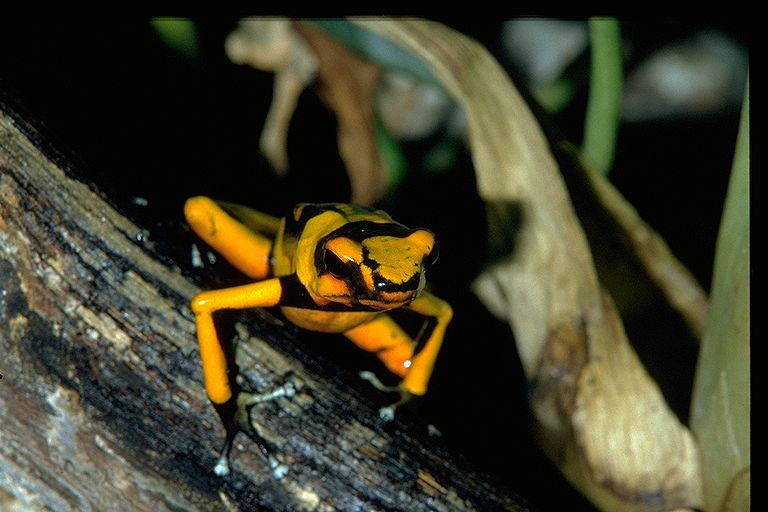
Copyright - Reto Siegenthaler, Schweiz (Dia från någon gång på 90-talet)
Jag hoppas att jag slipper se något om att någon här köpt djur från 'Valle del Cauca'. Det är en sak att chytriden slår ut djur, men när smugglare plockar de allra sista djuren och i detta fallet är det verkligen de sista djuren, så är det riktigt lågt.